Services — 01

Custom AI Models & Agents

Intelligent systems built for your specific tasks — from analysis and prediction to autonomous agents that handle work end to end.

Email Us →

What we build

/ 01

Task-specific models

Models trained and tuned on your data for the work you actually need — classification, prediction, extraction, analysis.

/ 02

Autonomous agents

Agents that carry a task from start to finish — reading, deciding, acting and reporting back — with clear guardrails.

/ 03

Human-in-the-loop control

You decide where people stay in the loop. Approvals, reviews and escalation are designed in, not bolted on.

How it works

01

Understand the task

We sit with the people doing the work and map exactly what the system needs to do — and what it must never do.

02

Prototype fast

A working prototype on your real data within weeks, so you can judge results — not promises.

03

Deploy & refine

We ship into your environment, monitor performance and keep improving the system as your business changes.

Built & shipped

Two of the systems behind this page — one running in production for a client, one a working proof of concept.

An AI marker that grades work and explains itself

In production
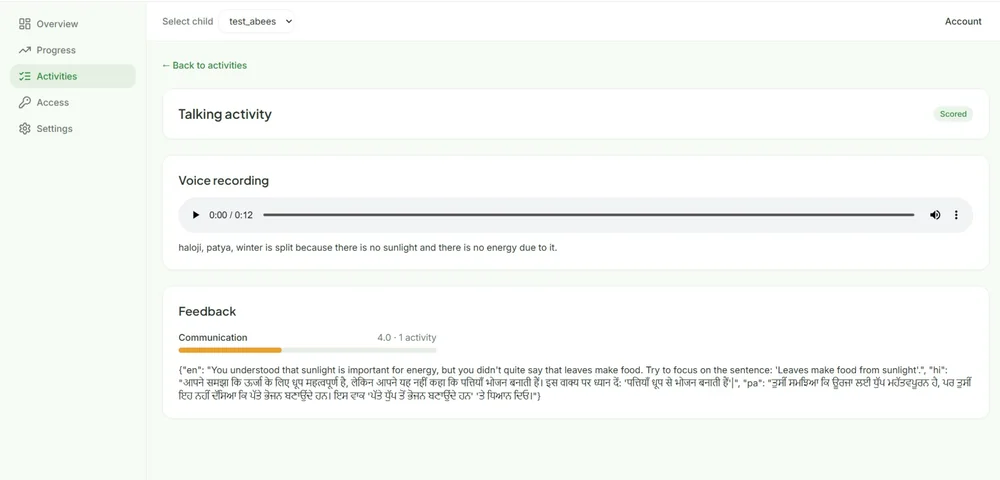
An activity detail screen showing a voice recording and the AI-generated feedback beneath it, with a communication score.
AI feedback on a spoken answer, with its score

Built for an education client. Submitted work is queued to an asynchronous evaluation worker that scores it against a rubric and returns structured, itemised feedback rather than a bare number. Every result is reviewable, and a human can override any score — the model proposes, a person decides.

The queue is the point: marking runs independently of the app, so a slow or failed evaluation never blocks a child or a parent, and a failed job retries with its error recorded.

  • FastAPI
  • Async worker queue
  • LLM evaluation
  • Postgres
  • Rubric scoring
  • Human override

Virtual ring try-on, entirely in the browser

Proof of concept

Hand tracking locates 21 landmarks per frame, a 3D ring is positioned and rotated onto the finger joint, and a depth occluder makes it pass correctly behind the finger as the hand turns — the detail that separates a convincing try-on from a sticker floating over a photo.

It runs client-side on the device. No frames leave the browser, so there is no video upload, no server cost per try-on and nothing to store.

  • MediaPipe Tasks
  • Three.js / WebGL
  • 21-point hand tracking
  • Depth occlusion
  • Runs on-device

The client platform is shown without naming the client or their product, and no real pupil data appears anywhere on this site.

Have a task an agent could own?

Tell us what’s eating your team’s time and we’ll show you what a custom model could do with it.

Email Us →